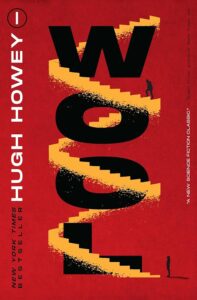
Wool has not only become one of the most important dystopian novels of the last two decades – it essentially invented a subgenre. The “sealed underground bunker, hostile surface, secrets kept from the population” setup has been done so many times now that it’s a well-worn trope, but Hugh Howey did it first (well, almost – more on that later) and I’d argue he did it best.
What makes Wool’s absolute dominance of the bunker subgenre all the more remarkable is how it happened.
Wool began as a short self-published piece Howey has described as “a depressing short story that I didn’t think anyone would care about but me.” Turns out he was very wrong about that. Readers wanted more so he wrote more. The series got included in the short-lived Kindle Worlds program, which invited other authors to tell stories set in the Silo universe. And now Apple TV’s Silo is one of the biggest successes of that platform.
Not bad for a story no one was supposed to care about.
But the reason Wool endures isn’t the publishing origin story – it’s the silo itself. Howey built one of the most fully realized closed worlds in dystopian fiction. The entire population lives in a single underground structure organized vertically: the higher your level, the more elite your status, and there’s only a single central staircase connecting the entire civilization. There are no elevators, only couriers – people whose entire job is moving things between levels. That’s the kind of load-bearing worldbuilding that not only tells you about the infrastructure, but illustrates what it’s like to exist in it.
And that verticality makes Wool one of the most claustrophobic reading experiences in the genre. When the main character, Juliet, begins exploring the flooded expanse beneath the mechanical level, the physical tightness of the world presses in on the reader in a way that very few books manage – and that’s all I can tell you without spoilers.
The only dystopian novel I’ve read that rivals Wool for pure claustrophobia is The Luminous Dead by Caitlin Starling, which is essentially cave diving for 400 pages straight, plus psychological warfare. But where The Luminous Dead sustains that tension through isolation, Wool builds on it with a mystery – who’s keeping the silo’s secrets, and why? That mystery drives the pace of the first book beautifully, giving you something to chase even when the worldbuilding alone would be enough to keep you reading.
I think Wool deserves more credit for its character development than it usually gets. This is a plot-driven book, no doubt, but the balance between plot and character is very well balanced. Juliet is easy to root for — stubborn, competent, and just reckless enough to be interesting — and the supporting cast earns their space on the page rather than simply filling roles around her.
Where the series falters for me is in Shift, which is book 2 and a prequel to book 1. After the momentum and tight focus on Juliet, Shift steps completely outside the timeline and leaves her behind to focus on what came before, and the structural shift is jarring. Howey himself has called the prequel “a risk” but he said it was what he wanted to write next, so he did. I respect the choice, I think the story he tells in Shift is equally as important as Juliet’s journey, but the execution pulls you out of the narrative. Shift reads like its own story wedged in the middle of another, and for some readers that pivot will land better than for others.
Dust, the finale, does pull the threads back together, but leaves more to the imagination than I personally prefer. Your mileage may vary — I’m still waiting for my husband to finish it so I can find out if he agrees with me or not.
If Wool sounds like your kind of book, I’d also recommend I Who Have Never Known Men by Jacqueline Harpman, the precursor to Wool that I alluded to at the beginning. First published in 1995, you’ll recognize the underground bunkers, barren wasteland, and atmosphere of dread.
Snowpiercer, the graphic novel written by Jacques Lob, takes Wool’s vertical class system and lays it on its side aboard a train, which makes for a fascinating structural parallel.
The Extinction Trials by A.G. Riddle uses a similar bunker setup but opens into a post-apocalyptic world that still has a functioning society.
And if it’s specifically Shift that hooks you – people staying conscious while everyone else sleeps, aware of what’s really happening while the rest of the population remains blissfully ignorant – Early Riser by Jasper Fforde captures that same unsettling energy.
I’ve written a full list of books like Wool with even more recommendations if you’re looking for your next read after the silo.
Find your next favorite dystopian read
My Ultimate Dystopian Starter Pack includes two Glassborn Chronicles novellas – a dystopian sci-fi series about scarcity, division and AI governance – as well as my top picks for the best dystopian books of all time.