
There’s a big difference between a world that’s gone wrong… and one that’s completely gone.
“Dystopian” and “post-apocalyptic” are often used interchangeably — but they mean very different things. They’re two of the most gripping subgenres in all of speculative fiction, and understanding the difference between them can change how you read the story — and which ones stick with you long after you’ve closed the book.
Let’s break down dystopia vs post-apocalyptic: what each term really means, how they overlap, and I’ll give you four incredible books that blend both in unforgettable ways.
What Is a Dystopia?
A dystopia is a fictional society — often set in the future — that appears orderly on the surface but is deeply flawed, unjust, or oppressive underneath. The word itself literally means “bad place,” and that’s exactly what a dystopia is: a controlled environment where some form of structure still exists, but that structure actively harms its people.
Dystopias usually involve:
- Authoritarian governments
- Surveillance, censorship, or social manipulation
- Rigid hierarchies and propaganda
- Citizens forced to comply, resist, or unravel
Think of The Handmaid’s Tale, 1984, or Divergent. The society is still functioning — but it does so by sacrificing freedom, truth, or humanity.
What Is Post-Apocalyptic Fiction?
A post-apocalyptic story takes place after a major world-ending event: nuclear war, plague, climate collapse, asteroid impact — you name it. The key here is collapse. Society is no longer functioning as we know it. Sometimes it’s completely gone, other times it’s barely hanging on.
Post-apocalyptic stories often explore:
- Survival after the fall
- Scarcity of resources
- Isolation and mistrust
- Rebuilding or redefining civilization
Examples include The Road, I Am Legend, and Station Eleven. These stories aren’t about a broken system — they’re about what happens when there’s no system left at all.
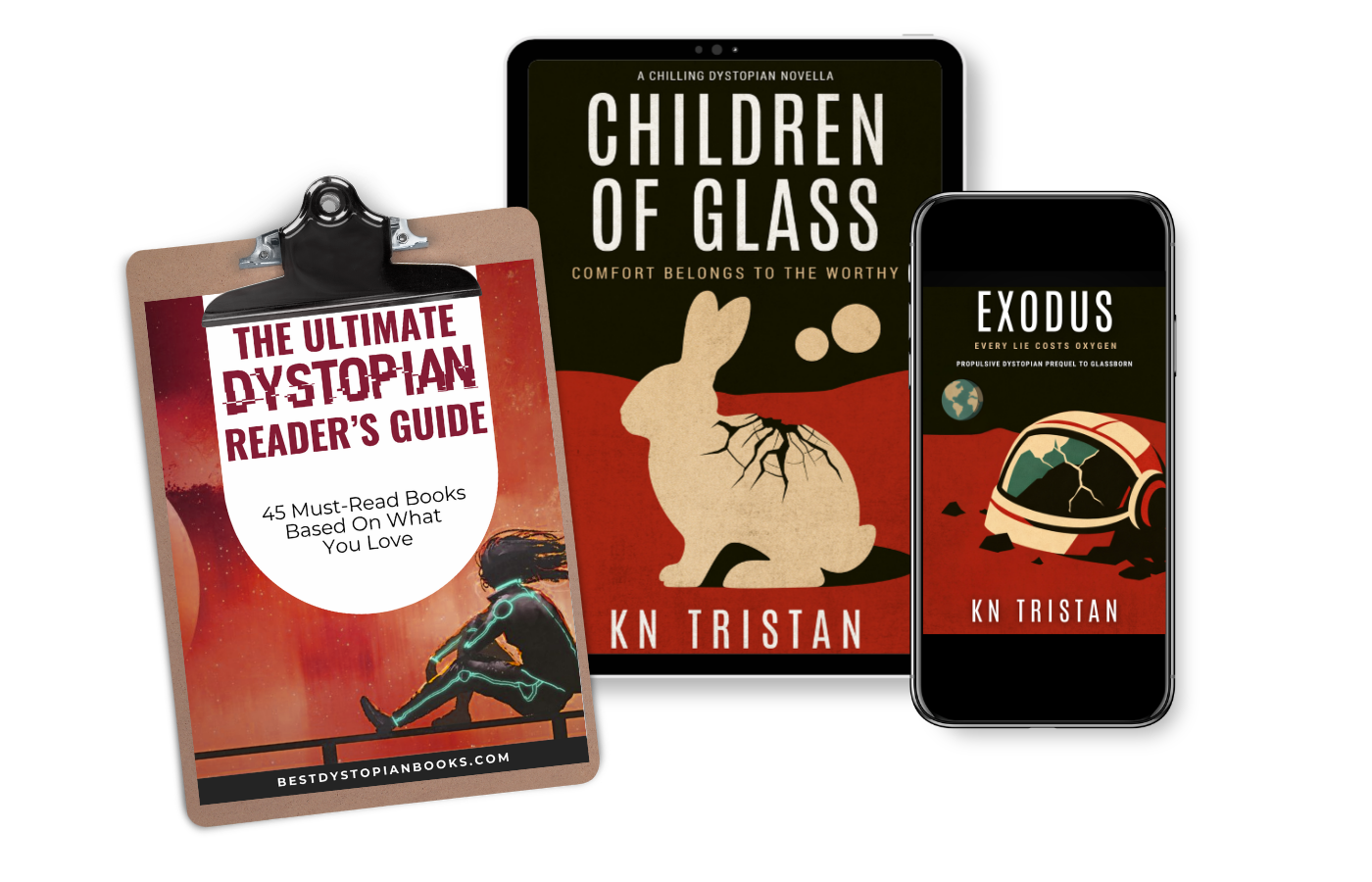
Find your next favorite dystopian read
My Ultimate Dystopian Starter Pack includes two Glassborn Chronicles novellas – a dystopian sci-fi series about scarcity, division and AI governance – as well as my top picks for the best dystopian books of all time.
Are They the Same? Nope. But They Can Overlap.
Here’s where things get interesting: dystopian and post-apocalyptic fiction aren’t mutually exclusive. They’re both subgenres of speculative or science fiction, and while they have different focal points, they often intersect.
Think of it this way:
A world can be post-apocalyptic without being dystopian — because if society has been completely obliterated, there’s no structure left to be “bad.” It’s just gone.
But a dystopia requires a structure — a system, a government, a hierarchy — something for characters to push back against. If that system grew out of a collapse or disaster, boom: you have a story that’s both.
Let’s look at four brilliant books that blur the line between the two.

1. Parable of the Sower by Octavia E. Butler
America has fallen apart under the weight of climate collapse, economic disaster, and unchecked violence. Society as we know it has fractured into armed enclaves, walled communities, and roving chaos. It’s post-apocalyptic by definition — the infrastructure is gone, the systems have failed.
But it’s also deeply dystopian.
The remnants of government cling to power through oppressive policies and religious extremism. The protagonist, Lauren Olamina, navigates not just lawlessness, but a world where control is reshaped by faith, violence, and desperation. The systemic rot still exists — it’s just mutated.
This novel is equal parts spiritual reckoning and speculative horror, and it’s a must-read for understanding how environmental and political collapse can feed each other.
📖 Get Parable of the Sower here.

2. Snowpiercer by Jacques Lob, Benjamin Legrand, and Jean-Marc Rochette
The world has frozen over. Humanity survives only aboard a massive, constantly moving train — a last-ditch effort to preserve life after an environmental catastrophe. So yes, this is firmly post-apocalyptic.
But then you meet the passengers.
The train is a microcosm of class warfare, oppression, and manufactured scarcity. The rich live in luxury at the front while the poor are packed like cargo in the tail. Every attempt at rebellion is violently crushed. The structure didn’t just emerge in the aftermath — it was engineered to keep the status quo in place.
Snowpiercer doesn’t ask what caused the end of the world. It asks: what systems are we willing to preserve, even when the world ends?
Love graphic novels? The dystopian genre has a lot of them, from adaptations of classics to incredible original material for all types of readers. Check out my round-up of the best the genre has to offer.

3. The Stranded by Sarah Daniels
An apocalyptic event has forced survivors onto cruise ships that now float endlessly offshore, unable to return to land. The specifics of the disaster are kept mysterious at first — but the societal setup is unmistakably dystopian.
The cruise ships, once temporary sanctuaries, have become floating authoritarian states. Surveillance is constant, punishment is swift, and everyone is stuck — physically, socially, and emotionally. Meanwhile, rumors swirl about what’s left on land… and who controls it.
This book is a masterclass in setting: part claustrophobic thriller, part political drama, part post-collapse survival. It’s about what happens when temporary safety becomes permanent control.

4. Wool by Hugh Howey
Imagine generations of people living underground in a massive silo, because the Earth’s surface is too toxic to survive. The world ended long ago — and what’s left is a bunker with rules no one questions, secrets no one tells, and punishments no one returns from.
This is Wool.
On the surface, it’s post-apocalyptic: a deadly environment, no access to the outside, remnants of tech long decayed. But underneath? It’s one of the most chilling dystopias in modern fiction. Every floor is a rung on a social ladder. Truth is controlled. Hope is dangerous.
And worst of all? The system works — until it doesn’t.
Want to know more? Check out my review of Wool.
Why This Matters for Readers (And Writers)
Understanding the difference between dystopia and post-apocalyptic fiction doesn’t just help you organize your bookshelf — it helps you understand what a story is trying to say.
- If you’re drawn to stories about survival, trust, and finding hope in ruin — you probably love post-apocalyptic fiction.
- If you’re fascinated by corruption, rebellion, and oppressive systems — you’re in dystopian territory.
- And if you want both? You’re in the sweet spot where societal collapse meets systemic control.
Knowing this also helps you find better recommendations, start smarter conversations, and (if you’re a writer) build better worlds.
Because sometimes, the world ends.
And sometimes, what comes after is even worse.