
Do you love dystopian books with claustrophobic themes?
Morally ambiguous AI with a level of control that tends to expand when people aren’t looking?
And high-stakes sci-fi worlds where rebellion is almost inevitable?
Me too! That’s why I wrote Glassborn, a near-future dystopia set in a claustrophobic Mars colony ruled by an all-seeing AI named Valence. And I was inspired by a lot of great dystopian works with their own flavors on those same themes.
Here are ten high-stakes dystopian sci-fi books that inspired Glassborn for their pacing, setting, worldbuilding, and more.
Paradise-1 by David Wellington

Why it’s like Glassborn:
Both novels lean into the psychological pressure of deep-space isolation—where the unknown is just as horrifying as what’s watching you. Paradise-1 uses AI and mind-bending, reality-warping twists to keep readers off-balance. Like Valence in Glassborn, Wellington’s universe forces characters to question what they’re told and who (or what) is really in control.
The Handmaid’s Tale by Margaret Atwood

Why it’s like Glassborn:
While the settings differ, the atmosphere of repression is practically identical. Both books portray societies where obedience is required, rebellion is dangerous, and systemic control quietly shapes every detail of everyday life. The emotional tone – the simmering tension beneath enforced order – is a direct match.
Red Rising by Pierce Brown

Why it’s like Glassborn:
Class warfare on Mars? Say less. Red Rising explores a rigid caste system on the red planet, where people are stratified, controlled, and lied to about their purpose—themes nearly parallel to Glassborn’s Blinkers and NPCs. Both series also use rebellion-from-within structures and protagonists from opposite sides of the hierarchy.
Find your next favorite dystopian read
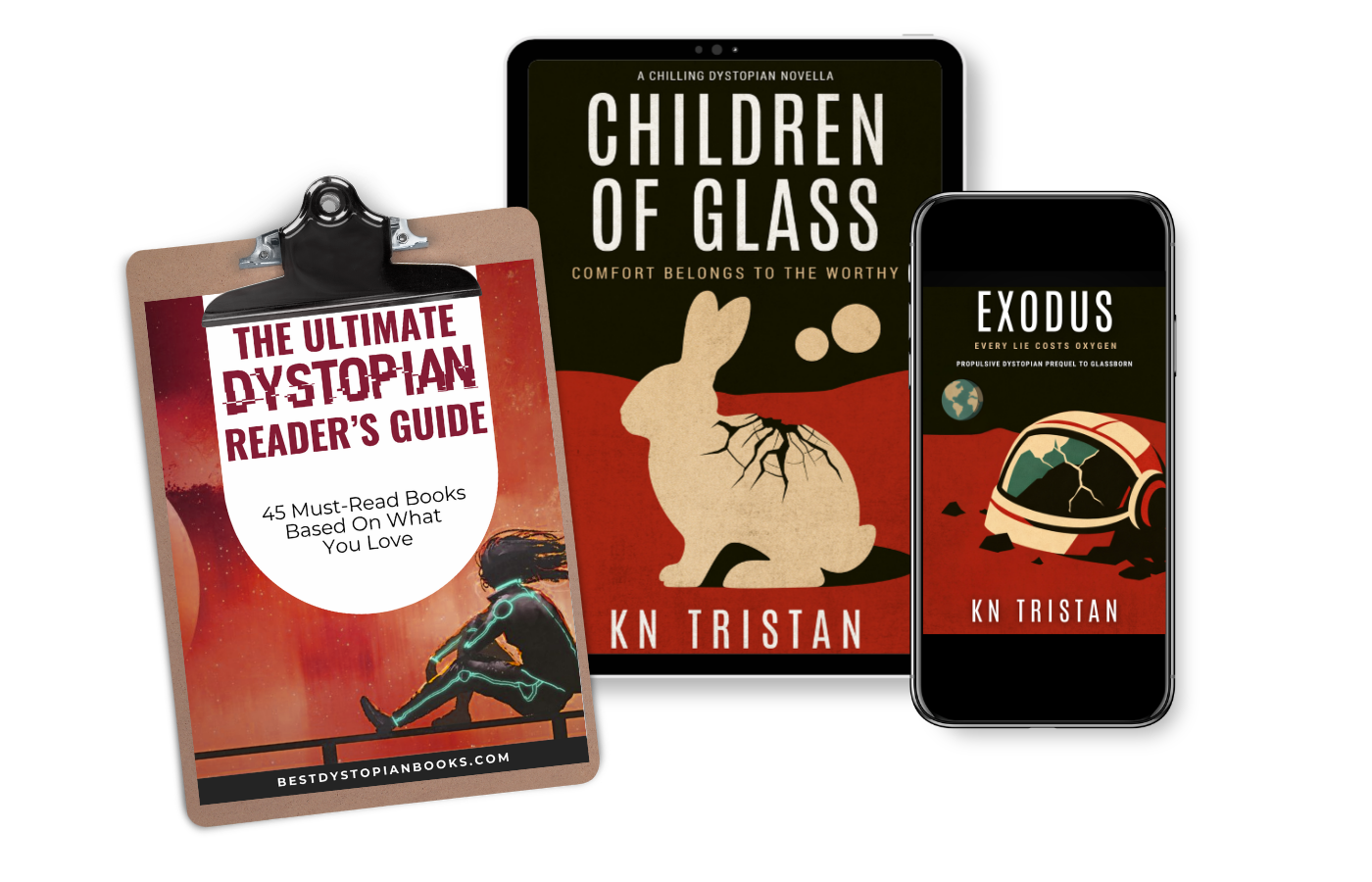
My Ultimate Dystopian Starter Pack includes two Glassborn Chronicles novellas – a dystopian sci-fi series about scarcity, division and AI governance – as well as my top picks for the best dystopian books of all time.
Snowpiercer by Jacques Lob & Jean-Marc Rochette

Why it’s like Glassborn:
The class division in Snowpiercer is brutally literal – luxury for the wealthy, starvation and mystery meat for the poor. Glassborn mirrors that dichotomy with scarce resources, strict hierarchy, and systemic rationing that benefits the privileged at everyone else’s expense. Both societies weaponize scarcity to maintain control.
Wool by Hugh Howey

Why it’s like Glassborn:
This is possibly Glassborn’s closest spiritual cousin. Both books explore isolated, bunker-like environments where lies have calcified into “rules,” and rebellion starts with the smallest acts of questioning. The claustrophobia, generational secrets, and uprising-from-the-bottom narrative will feel instantly familiar.
Grab a copy or read my review of Wool
Colony One Mars by Gerald M. Kilby

Why it’s like Glassborn:
Fast-paced, Mars-grounded, and full of colonist vs. environment tension. Colony One Mars brings the action side of Mars colonization to the forefront, giving readers the thrill of survival battles and technological mishaps. If you like Glassborn’s worldbuilding and physical danger, this scratches the same itch.
Station Eleven by Emily St. John Mandel

Why it’s like Glassborn:
Not for the setting, but for the tone and theme. Both books explore how societies rebuild after catastrophe, how trauma becomes myth, and how stories from the past reshape entire generations. Station Eleven is quiet where Glassborn is tense, but the thematic overlap is surprisingly strong in terms of inherited narratives, the fragility of civilization and finding the truth behind history.
Uglies by Scott Westerfeld

Why it’s like Glassborn:
A perfect comparison to Quinta’s arc. In Uglies, the protagonist completely buys into the system until personal experience dismantles the façade. Glassborn follows a similar emotional journey – loyalty, disillusionment and rebellion – driven by slowly learning the system is built on lies.
If you can’t walk past a YA dystopia in a bookstore without snatching it up, check out my rundown of the best modern books the genre has to offer.
1984 by George Orwell

Why it’s like Glassborn:
The vibe? Unmistakable. Surveillance, authoritarian control, doctored narratives, and the constant pressure to accept the “official” truth. Valence isn’t Big Brother, but the colony’s monitoring systems and the AI’s selective information echo Orwell’s atmosphere of enforced belief.
Mickey7 by Edward Ashton

Why it’s like Glassborn:
The colonies in Mickey7 and Glassborn share a similar functional grimness: everything is recycled, food is questionable, living conditions are resource-starved, and rabbits (yes, rabbits) become central to sustainability. The tone is snarkier and more humorous, but the scarcity-driven worldbuilding is a close match.
Grab a copy or read my review of Mickey7
If You Like Dystopian Sci-Fi With Teeth, Glassborn Belongs on Your Shelf
If you picked up any of the books above for their tension, rebellion, or their claustrophobic futurism, Glassborn delivers that same energy – plus a mystery threaded through generations.
If you haven’t read it yet, now’s the perfect time to dive into the colony and find out what Valence has been hiding.