
Okay, don’t get me wrong – I couldn’t put down The Long Walk by Stephen King, and I had a great time watching the movie. But no matter how else you might feel about them, neither the book nor the movie come close to passing the Bechdel test.
If you need a refresher or haven’t heard of it, the Bechdel test was created by cartoonist Allison Bechdel in 1985 to assess whether female characters are being marginalized. Passing the test requires just three things:
- Two or more female characters…
- Who talk to each other…
- About something other than a man.
The Long Walk is a very limited environment – 50 (or 100, depending on your source material) eighteen-year-old men walking on a road until all but one drops. There are guards in tanks (all men) and TV cameras (because the dystopia will be televised, of course) and occasionally crowds.
These crowds are the only time we see women in the book, and the movie features a few scenes with the main character’s mom. Ray’s mom talks to his girlfriend in the book, but only about Ray and very briefly.
Sorry, Stephen, Allison Bechdel and the rest of us would like to have a word with you.
The Long Walk was published under King’s pseudonym, Richard Bachman, in 1979, but it was actually written significantly before that, predating Carrie. So it’s understandable to imagine an author writing in 1966 choosing not to subject “the fairer sex” to an event like The Long Walk. That explains why none of the contestants or military guards are women – to brush off a well-worn excuse, this book (and the 2025 movie, which stuck closely to the source material), was a product of its time.
You know what else is often written off as “product of its time” syndrome? Racism and whitewashing. And The Long Walk has plenty of that too – that’s a bingo! One character is described as Black, and then it’s never mentioned again, which is probably a good thing because King is not known for his diverse casts or sensitive word choices, especially early in his catalog.
This is one thing the movie absolutely improved upon, and David Jonsson is perfection in the role of McVries. He upstaged Cooper Hoffman’s Ray on multiple occasions and made me wonder who the main character really should have been.
The Long Walk is still a great story – immersive, a signature King page-turner, the Presidential Fitness Test taken to its absolute most extreme. But in the sparsely described world of the book, a very narrow slice of the population is represented. So many more voices from a much wider scope of experiences are able to tell their stories now.
Here are 5 diverse dystopian books that will give you the same teens being volun-told to participate in grossly unfair systems vibes as The Long Walk.
Internment by Samira Ahmed

This book leans closer to near-future political fiction than a full-on dystopia, and it feels terrifyingly realistic. It’s about a Muslim teenager forced into a 1940s-style American internment camp. Layla plays by the rules to avoid drawing attention to herself, but she never bows to what the guards think she should be.
Legend by Marie Lu

The worldbuilding in Legend feels similar to The Long Walk – a country fractured and at war with itself, training its young people up to toe the party line while ignoring the less convenient facts about society. But where King’s worldbuilding is sparse, Lu’s is rich with detail, history and visual interest.
Find your next favorite dystopian read
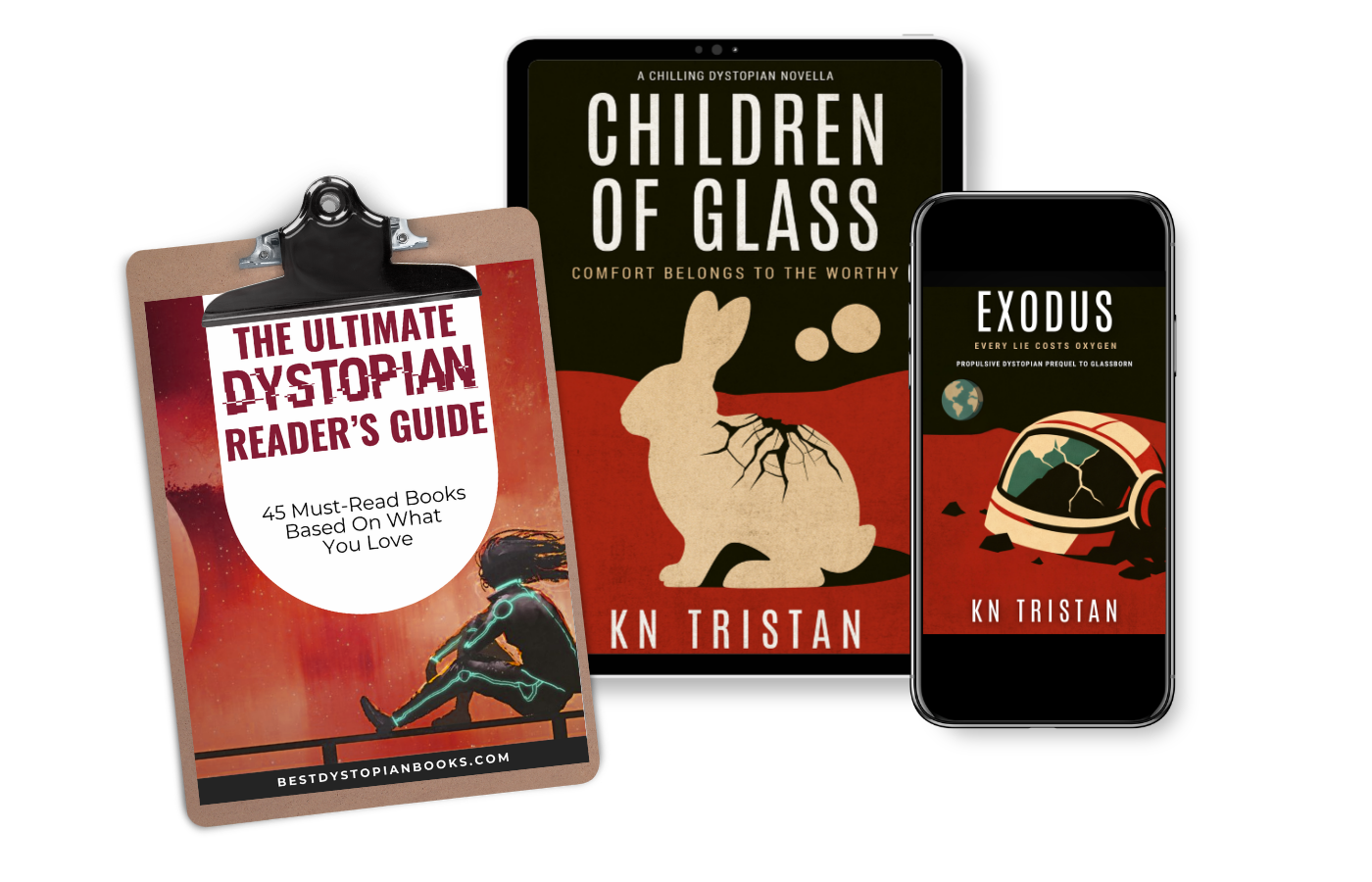
My Ultimate Dystopian Starter Pack includes two Glassborn Chronicles novellas – a dystopian sci-fi series about scarcity, division and AI governance – as well as my top picks for the best dystopian books of all time.
I Who Have Never Known Men by Jacqueline Harpman

Okay, I admit it, I put this on the list as a sort of reverse Bechdel test. There are six (living) men in this book about forty women trapped in an underground bunker with no memory of how they got there or why they’re being held. The men don’t speak to anyone, and if they did, it’d likely be about the women. This one’s literary, mysterious, and atmospheric.
Dry by Jarrod and Neal Shusterman

Who would you expect to keep their shit together the best and make the best efforts at survival in a crisis where all the water in California has dried up? The dumb teenagers? They’re not so dumb in this one! They have survival skills, more common sense than most of the adults, and they go on a very Long Walk-esque journey to find water.
Parable of the Sower by Octavia E. Butler

This book transcends the teenage years. The story begins when the main character is a child with little understanding of the increasingly powerful Christian nationalist movement taking over the country, and we follow her into adulthood as she grows into a spiritual leader as well as a revolutionary. There’s a walking tour of the American roadways in this one too, and the west coast setting gives it both echoes of The Long Walk and a Grapes of Wrath revisited vibe.
Literature was once the near-exclusive domain of white men — both as authors and as main characters. Thankfully, we now have more publishing opportunities than ever, and a much wider range of voices telling stories in this genre.
The Long Walk is a gripping, fast-paced read that doesn’t need to be retired just because it comes from that older, narrower era. But when paired with diverse dystopian books that explore similar themes from different perspectives, readers gain a deeper understanding of what the genre looks like — and who it impacts — across the full spectrum of human experience.