
Feminist dystopian books are not subtle stories.
They’re written in response to real-life pressures to regulate women’s bodies, police their behavior, and enforce obedience through law, surveillance, and shame.
They’re stories about gendered power made explicit – about what happens when women’s autonomy is targeted and attacked.
From the century-plus battle for women’s suffrage to modern rollbacks that we must be constantly on our guard against, women know this lesson in their bones: progress is conditional, and it’s not linear.
Feminist dystopian fiction takes these everyday challenges and pushes them to their logical, terrifying conclusions. The genre which has its roots in books like The Handmaid’s Tale has recently seen an expansion into raw, urgent and powerful stories being told in indie spaces – spaces that don’t ask for permission, that allow us to speak our minds even when it’s terrifying, even when it’s dangerous.
These books feed a very specific hunger: a gnawing understanding that the system is stacked against us, and we have no choice but to fight back.
Foundational Feminist Dystopias
These books have shaped the language of feminist dystopian fiction. They interrogate systemic control with precision, restraint, and philosophical weight, asking what happens when gendered laws, surveillance, and punishment are normalized.
The Handmaid’s Tale by Margaret Atwood

The keystone of feminist dystopian fiction, The Handmaid’s Tale depicts a theocratic regime that reduces women to their reproductive function. Through rigid gendered laws, it shows how authoritarian systems use fear and order to create obedience.
I Who Have Never Known Men by Jacqueline Harpman

This quiet, haunting novel follows women imprisoned without explanation, cut off from society, language and their own identities. I Who Have Never Known Men strips oppression down to an isolation so complete, it erases the very idea of selfhood.
The Power by Naomi Alderman

The Power flips the usual script by giving women a biological advantage over men. More than a simple revenge fantasy, this book dives deep into the ways power corrupts, how it perpetuates harm, and whether it can ever be wielded without moral damage.
Find your next favorite dystopian read
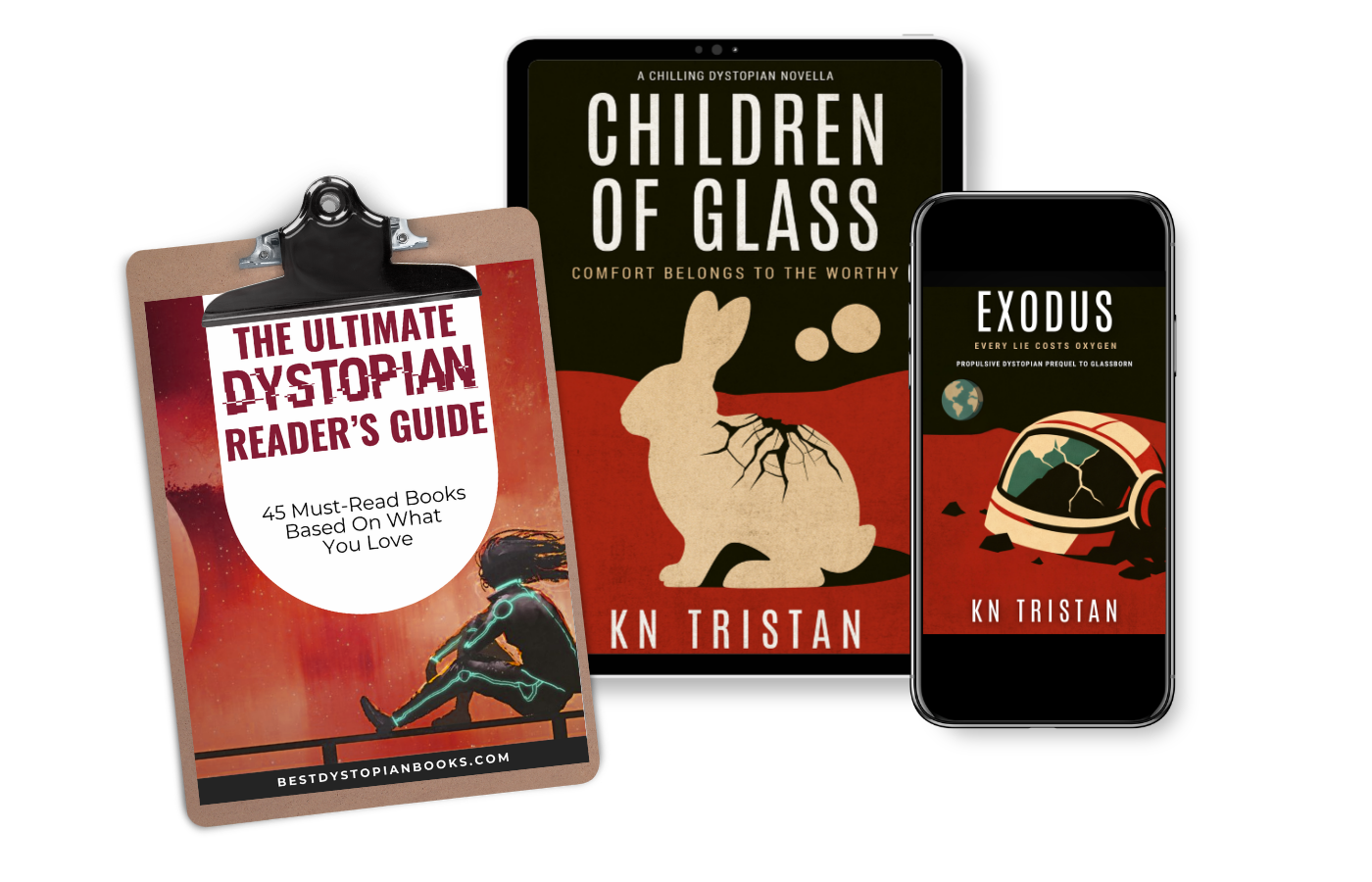
My Ultimate Dystopian Starter Pack includes two Glassborn Chronicles novellas – a dystopian sci-fi series about scarcity, division and AI governance – as well as my top picks for the best dystopian books of all time.
Indie Feminist Dystopias Carrying the Torch Forward
Books like The Handmaid’s Tale and The Power shaped the language of feminist dystopia, but they’re not where the genre stopped. The most urgent explorations of women’s autonomy and control are now happening outside traditional publishing. These books speak bluntly and sometimes brutally about bodily autonomy, gendered violence, and systemic cruelty.
Silent Y by Katherine Benfante

In Silent Y, men and women have separated completely, but the women’s new society is still shaped by the shadow of masculinity. Memories of violence, control, and manipulation – both personal and inherited – linger long after physical separation. Nowhere is that tension more fraught than in the one system that still requires cooperation between the sexes: reproduction, where fear, history, and power collide in ways the new world has not fully reckoned with.
The Nocere by Heather Carson

In The Nocere, most of humanity has retreated into a virtual realm, leaving behind a crumbling society. But every society has its seedy underbelly, and inside the digital paradise, women’s bodies become entertainment – commodified, brutalized, and disposable. Violence against women is normalized as spectacle, exposing what happens when systems prioritize male desire and escape replaces responsibility.
The Fertile Ones by Kate L. Mary

In The Fertile Ones, declining birth rates allow the government to claim ownership over fertile women’s bodies in the name of survival. Women are monitored, scheduled, and compelled to reproduce through invasive systems that reduce autonomy to a biological function. As the story escalates into forced isolation and increased surveillance, we see how quickly reproductive “duty” becomes incarceration and coercion is reframed as protection.
Donate by Emma Ellis

Donate flips the familiar reproductive dystopia on its head. The world is vastly overpopulated and Mae discovers she is pregnant on the same day her authoritarian government institutes a strict “one in, one out” policy in regard to human life. If she wants her baby to survive, she has to find someone willing to die. This book asks who gets to decide which lives are worth preserving, and at what cost.
Eden Rising by Shade Owens & Ash S-J

Eden Rising explores a post-collapse world fractured into isolated factions, including a walled society built to protect the women living there. Inside Eden, fear of men is considered necessary and rigid rules keep the women safe – until an impossible choice is presented to them and suddenly that rigidity becomes brittle and the rules curdle into a new kind of oppression.
Feminist dystopian books endure because they do more than reflect fear – they give us something to do about it.
They offer catharsis by indulging in shared anger, they can create momentum to help us continue the fight, and they remind us that resistance has always been part of women’s history.
These stories are not warnings pulled from thin air – they’re echoes of battles already fought, lost, won, and fought again.