
Dystopian fiction is one of those genres that feels instantly recognizable—grim worlds, oppressive regimes, and protagonists fighting against the odds. But exactly what makes a book dystopian? Is it just bleak vibes and a crumbling society, or is there something more specific going on?
Let’s dive into what defines dystopian fiction, how it differs from related genres like post-apocalyptic or speculative fiction, and look at standout examples across the eras, from Orwellian classics to the 2012 YA boom, from indie gems to modern traditionally published hits.
What Makes a Book Dystopian?
At its core, dystopian fiction is about a society gone wrong.
It usually explores what happens when a government, corporation, ideology, or social system gains too much control. The resulting world, while functioning on the surface, is deeply broken. These stories often serve as cautionary tales, warning us about the dangers of unchecked power, lost freedoms, and the slippery slope of “for the greater good.”
Unlike post-apocalyptic fiction, which focuses on the aftermath of a societal breakdown, dystopias have order—just the wrong kind. They’re systems that work… for some. Often, a select few benefit while the rest suffer in silence (or quietly plot rebellion).
And unlike grimdark or horror, dystopian stories usually involve some glimmer of hope or resistance. There’s often a spark—however faint—of rebellion, revelation, or human resilience. The point isn’t just to suffer in a terrible world. Tt’s to question that world and find a way out.
What Dystopian Fiction Is Not
It’s easy to conflate dystopia with similar genres, so here’s what dystopian fiction typically isn’t:
- Post-apocalyptic stories may feature a destroyed society or survival in the ruins—but without a functioning, oppressive system.
- Speculative fiction can include dystopias, but also utopias, sci-fi comedies, and other what-if scenarios. Like scifi at large, it’s an umbrella genre that contains dystopian fiction.
- Political thrillers and social satire may feature corrupt governments, but if they’re set in our current world without systemic control taken to an extreme, they’re not usually dystopias.
- Fantasy societies with tyrannical rulers aren’t automatically dystopian. A dystopia needs a system that mirrors real-world dangers in a plausible or exaggerated near-future.
12 Great Examples of Dystopian Fiction
To get a full picture of the genre, let’s look at some defining books across four categories: classics, the 2012 YA boom, indie books, and modern trad-pubbed books.
Classic Dystopias
These books are the foundation of the genre. They made readers squirm decades ago and still hit hard today.
1984 by George Orwell

The quintessential dystopia. Surveillance, censorship, thoughtcrime—it’s all here. Orwell didn’t just invent the genre’s vocabulary (Big Brother, thoughtcrime), he wrote a chilling tale about the loss of truth in a totalitarian regime.
Brave New World by Aldous Huxley

Instead of fear and force, Huxley shows a society controlled by pleasure, distraction, and genetic engineering. It’s a world where rebellion is unnecessary—because no one wants to rebel. Creepy and eerily relevant in the age of algorithmic bliss.
Fahrenheit 451 by Ray Bradbury

In a society where books are banned and firemen start fires, one man begins to question everything. Bradbury’s warning about censorship and media manipulation still resonates, especially in today’s attention economy.
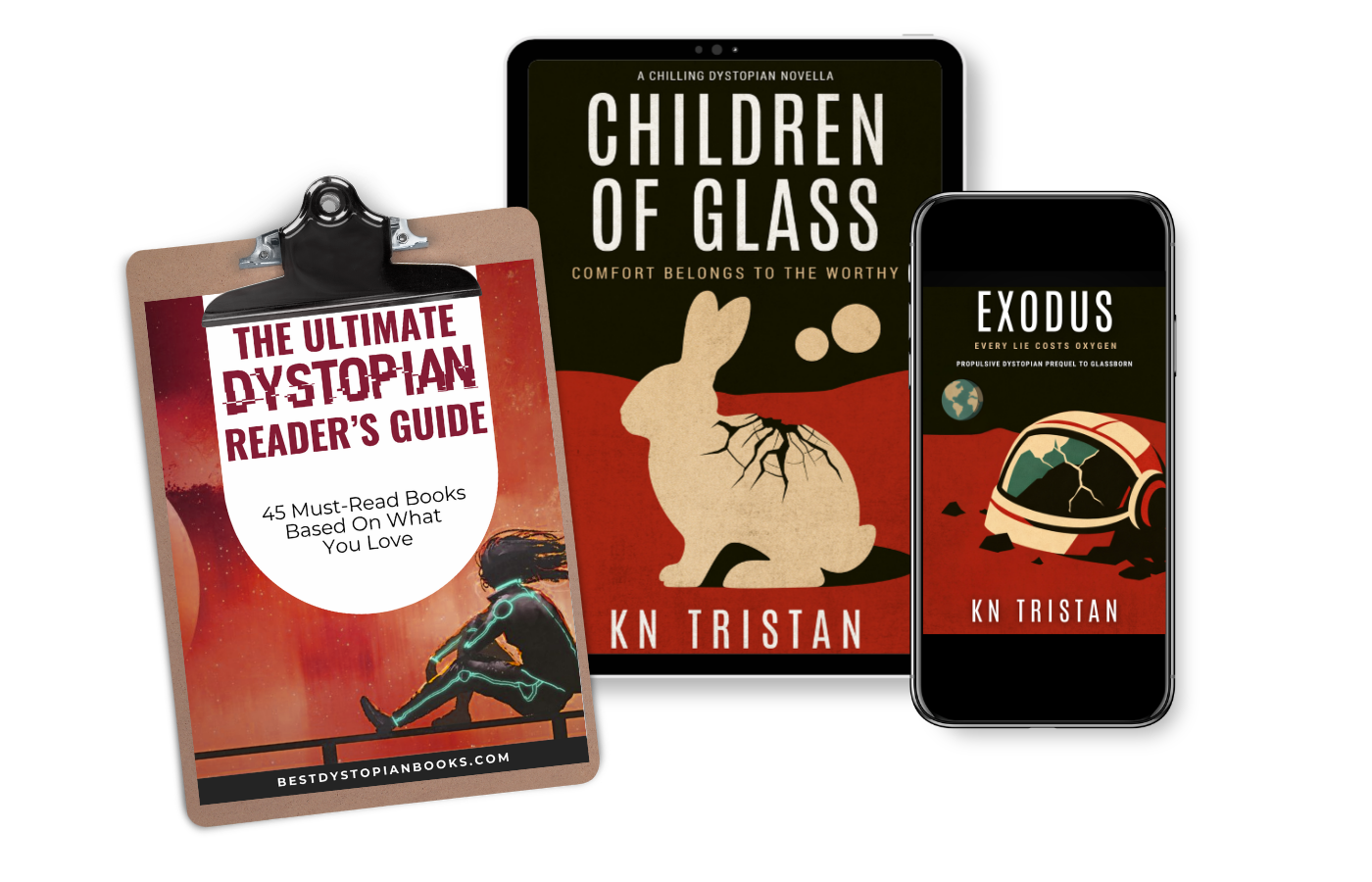
Find your next favorite dystopian read
My Ultimate Dystopian Starter Pack includes two Glassborn Chronicles novellas – a dystopian sci-fi series about scarcity, division and AI governance – as well as my top picks for the best dystopian books of all time.
2012-era YA Dystopian Boom
The Hunger Games didn’t invent the trend, but it sure launched it into the stratosphere. These books made dystopia cool for a new generation.
Replica by Lauren Oliver

Told from alternating perspectives—one of a girl raised in a mysterious facility, the other of a girl on the outside—Replica explores identity, autonomy, and the ethics of cloning in a fragmented, surveillance-heavy world.
The Program by Suzanne Young

In a society where teen suicide is considered a contagious disease, troubled youths are forcibly “cured” in a government-run facility that wipes their memories. It’s a chilling look at mental health, consent, and control.
Legend by Marie Lu

Set in a militarized future America, Legend follows two teens on opposite sides of a corrupt system. With themes of inequality, surveillance, and rebellion, it’s a fast-paced thriller with sharp political undertones.
The 2010s dystopian boom gave rise to a whole new niche within the genre which is still going strong today. Check out my favorite modern YA dystopias for fans of The Hunger Games.
Indie Dystopian Standouts
From breakout hits like Wool to lesser-known gems, indie authors are pushing the genre in bold, boundary-breaking directions.
Donate by Emma Ellis

With population levels out of control, the state enforces a brutal exchange: for every new child born, someone else must die. But it’s not just the policy that’s terrifying—it’s the way society turns on pregnant women with suspicion, fear, and violence.
The Cure by KA Riley

In The Cure, turning eighteen is a death sentence—unless you earn the right to survive. Ashen is pulled from poverty and thrust into a world of luxury and secrets, serving the elite while trying to prove she’s worthy to live.
Wool by Hugh Howey

Originally self-published, Wool takes place in a massive underground silo where humanity has lived for generations, cut off from the toxic world above. As secrets unravel, the cost of obedience becomes horrifyingly clear.
Want to know more? Check out my review of Wool.
Modern Traditionally Published Dystopias
Today’s traditionally published dystopias are less about death games and more about nuanced systems, slow-burn resistance, and emotional truth bombs.
Mickey7 by Edward Ashton

Every time Mickey dies, he wakes up in a new clone body—with all the memories of the one who came before. This clever, darkly funny novel explores expendability, identity, and what it means to be human in a high-stakes colony.
Want to know more? Check out my review of Mickey7.
Manhunt by Gretchen Felker-Martin

Set in the aftermath of a pandemic that mutates cis men into violent monsters, Manhunt is a searing, bloody tale of survival. Trans women at the center of the story navigate brutal factionalism, medical horrors, and their own right to exist.
The Seep by Chana Porter

After an alien invasion transforms Earth into a post-capitalist utopia, one woman begins to question whether the price of happiness is too high. The Seep is surreal, queer, and deeply introspective—dystopian not because of violence, but because of the erasure of grief and choice.
Common Tropes in Dystopian Fiction
While every dystopia is different, many share recurring themes and worldbuilding elements:
- Surveillance and control – constant monitoring, digital tracking, curfews, or informants
- Class divides – stark inequality, caste systems, elite vs. underclass
- Propaganda – false histories, state-controlled media, rewritten truths
- Rebellion or resistance – a character who begins to question the system
- False utopias – everything seems perfect… until it isn’t
- Symbolic objects or slogans – can be government propaganda or what the resistance rallies around
If you’re seeing two or more of these, there’s a good chance the book you’re reading is dystopian.
So… Why Do We Read Dystopian Fiction?
Because it lets us explore what could go wrong before it does.
Dystopias are cautionary tales. They take real-world problems like surveillance, inequality, climate collapse, and fascism and crank the dial until the consequences are too big to ignore. Reading them gives us a safe way to think about danger, resilience, and resistance.
These books remind us that even in the worst circumstances, someone always dares to ask: What if we say no?