
It’s 2025, and it feels like we’re holding our collective breath.
Across the globe, people are watching systems strain, rights get challenged, resources disappear, and the truth become harder to pin down. We’re overwhelmed, overloaded, and not always sure how to make sense of the world around us. For many of us, it feels like history is being rewritten in real-time — and not in a good way.
And a lot of people are asking: Why would anyone want to read dystopian fiction right now?
Because dystopian stories aren’t just about despair. They’re about resistance.
And sometimes, imagining the worst is the only way to start building something better.
Why Resistance Fiction Matters
The best dystopian stories don’t just show us broken futures. They show us how people react. They ask hard questions:
- What does it mean to have autonomy in a world that wants to control you?
- Who gets to decide what’s true, what’s beautiful, what’s valuable?
- How do we push back against power that wears a friendly face?
- What happens when survival isn’t enough — when we still crave meaning, community, and justice?
These books reflect anxieties many of us carry every day — about climate collapse, digital surveillance, disinformation, erosion of rights, and the growing influence of unchecked wealth. But resistance fiction reframes that fear. It gives us characters who question, who disobey, who imagine new paths even when the odds are against them.
That’s why these stories matter more than ever. Not because they predict what’s coming — but because they remind us we still have a choice in what comes next.
What Counts as Resistance?
Resistance in fiction can look like organized rebellion — the masked anarchist blowing up Parliament, the ragtag crew taking on a megacorp. But it can also be smaller, more personal:
- Saying “no” when silence is safer
- Preserving art, memory, or meaning when the world says it’s worthless
- Holding space for joy, softness, and community when cruelty feels inevitable
- Refusing to give up your sense of self, even when the system demands it
Find your next favorite dystopian read
My Ultimate Dystopian Starter Pack includes two Glassborn Chronicles novellas – a dystopian sci-fi series about scarcity, division and AI governance – as well as my top picks for the best dystopian books of all time.
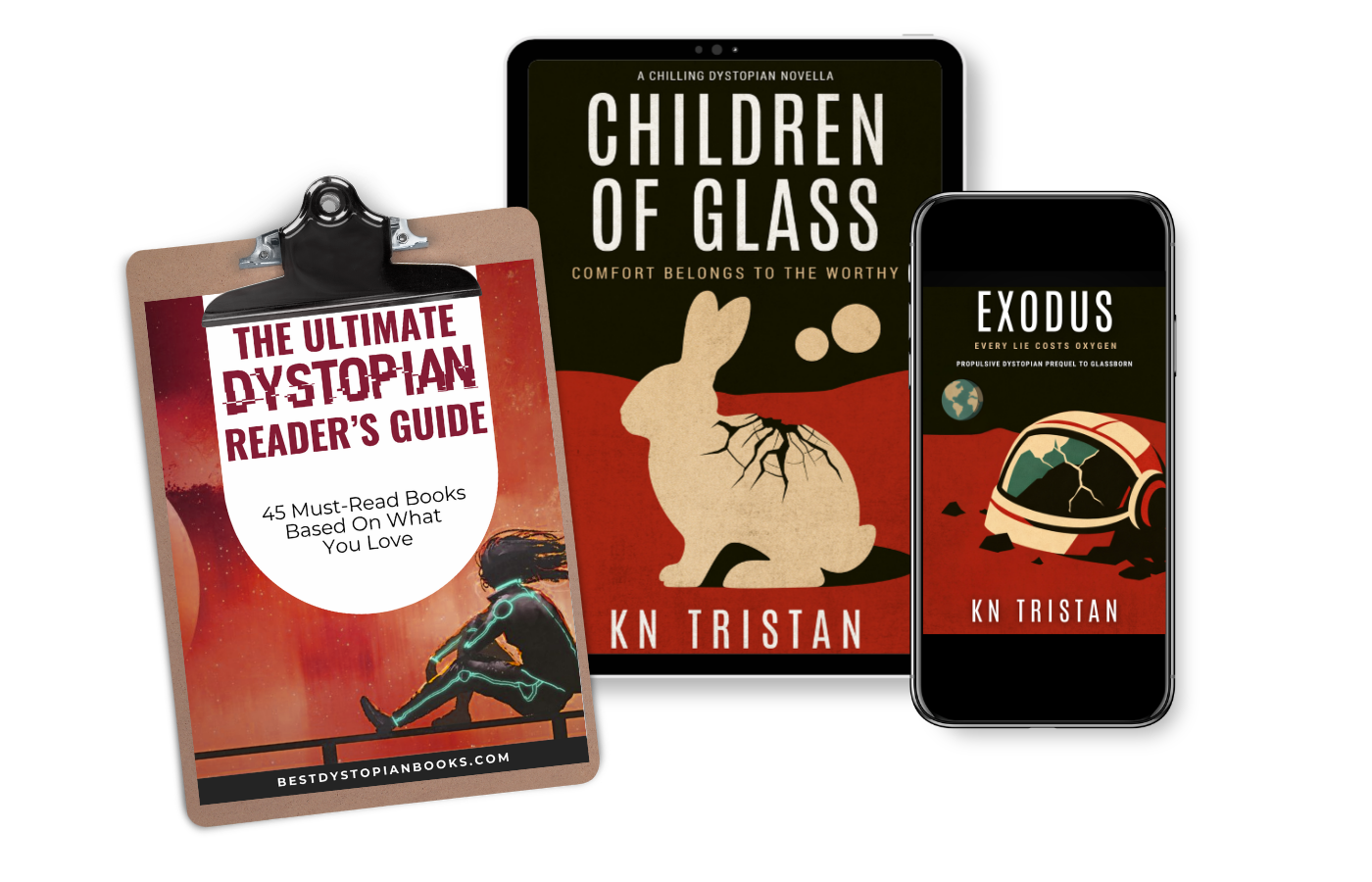
The following books celebrate all forms of resistance — some loud, some quiet, all powerful.

1. V for Vendetta by Alan Moore and David Lloyd
This graphic novel (and its film adaptation) is one of the most iconic pieces of resistance fiction ever created. Set in a future fascist Britain where media is censored and dissent is punished, V for Vendetta explores what happens when one masked revolutionary sparks a nationwide rebellion.
It’s political, theatrical, and unapologetically angry — but it also asks: how do ideas survive, even when people don’t?

2. 1984 by George Orwell
No list of resistance fiction is complete without 1984. The world of Big Brother is built on surveillance, censorship, and enforced conformity — a world where even your thoughts aren’t safe.
Winston Smith’s rebellion is quiet and internal: writing in a journal, seeking truth, daring to love. But in a world designed to erase individuality, even that is an act of war.

3. Fahrenheit 451 by Ray Bradbury
In Bradbury’s world, books are banned and “firemen” burn them to prevent independent thought. But Fahrenheit 451 isn’t just about censorship — it’s about the power of ideas, and how even in the absence of knowledge, curiosity can survive.
Montag’s journey from loyal enforcer to quiet rebel shows how resistance starts with questions — and grows into action.

4. The Unincorporated Man by Dani and Eytan Kollin
This underrated gem explores a future where every person is incorporated at birth, and their shares are owned by parents, government, and corporations. Autonomy? Only available if you can afford to buy it back.
When a man from the past wakes up from cryosleep and refuses to be commodified, the entire system is challenged. It’s a sharp critique of capitalism, surveillance, and identity — and a fascinating exploration of what happens when profit becomes policy.
📖 Get The Unincorporated Man here.

5. Manhunt by Gretchen Felker-Martin
Raw, brutal, and emotionally explosive, Manhunt is a post-apocalyptic story about gender, survival, and community. After a virus turns anyone with high testosterone into a feral killer, the world splits into violently polarized factions. Amid the chaos, trans women fight not just to survive, but to exist on their own terms in a world that’s violently hostile to them.
It’s a visceral, bloody story that tackles toxic masculinity, bodily autonomy, and the right to exist without explanation. Resistance here is messy, fierce, and painfully human.

6. Uglies by Scott Westerfeld
Set in a future where everyone undergoes cosmetic surgery at 16 to become “Pretty,” this YA classic is a sharp critique of beauty standards, media control, and conformity. When Tally Youngblood learns what’s really behind the transformation, her decision to rebel ripples across society.
Uglies reminds us that resistance can start with questioning what we’ve been taught about worth — and who decides who’s allowed to matter.

7. Station Eleven by Emily St. John Mandel
Resistance doesn’t always look like revolution. Sometimes, it looks like art.
In Station Eleven, a traveling theater troupe performs Shakespeare across a post-apocalyptic landscape — a way to keep beauty and humanity alive even after everything else has fallen apart. The story weaves survival and meaning, reminding us that resistance can be cultural, emotional, and deeply personal.

8. A Psalm for the Wild-Built by Becky Chambers
This novella doesn’t feature a war or a rebellion — but make no mistake, it’s resistance fiction.
In a quiet future where robots gained sentience and peacefully walked away from human society, a tea monk and a curious robot journey together in search of purpose. What they find is a gentle critique of burnout, productivity culture, and our fractured relationship with the natural world.
It’s resistance through reflection. Through rest. Through saying, What if we didn’t live like this?
📖 Get A Psalm for the Wild-Built here.
A Psalm for the Wild-Built ranks very high on my list of dystopian societies I think I could survive. Check out the others, or find out which dystopian hellscapes I’d be first to die in.
Final Thoughts: Stories That Fight Back
We don’t read resistance fiction because we want to be afraid. We read it because we already are — and we need to remember we’re not alone.
Dystopian books give us language for what feels wrong, and visions for how we could fix it. They remind us that asking questions is powerful. That saying “no” is powerful. That even when the world feels like it’s unraveling, we can choose to imagine something better.